
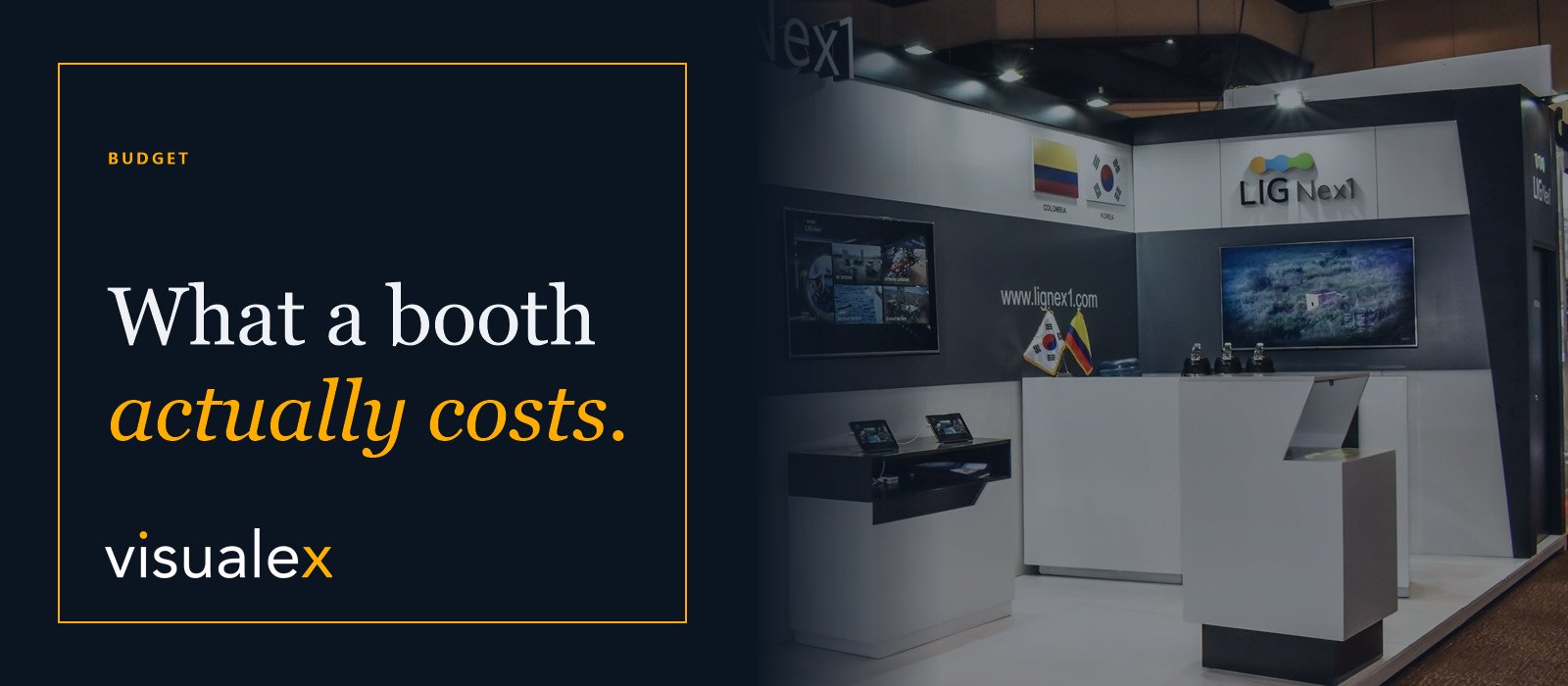
Nobody can quote your booth before knowing what goes inside it. That is not evasion. It is the reason two booths of identical square footage can differ by a factor of three.
What follows are the ranges we work in for NPE2027, and more usefully, the reasoning that puts a given project at the top or the bottom of its range. Treat them as a sanity check on the quotes you are comparing, not as a price list.
Ranges by footprint
These cover design, fabrication, graphics, and install and dismantle. They do not cover show services, which are ordered through the official contractor and billed at cost.
- ✓10 x 10, 100 sq ftTen to fifteen thousand dollars. What moves it: furniture, screens, shelving, and whether you need a lockable storage closet inside a hundred square feet.
- ✓10 x 20, 200 sq ftEighteen to thirty thousand dollars. What moves it: a meeting area, a real product display, and whether the graphics work on one level or two.
- ✓20 x 20 island, 400 sq ftForty-five to eighty thousand dollars. What moves it: a hanging sign, four finished elevations instead of one, and structural engineering.
- ✓20 x 30, 600 sq ftSeventy to one hundred and twenty thousand dollars. What moves it: an enclosed meeting room, machinery integration, and utilities.
- ✓20 x 40 and larger, 800+ sq ftFrom ninety-five thousand dollars. What moves it: multiple zones, heavy utilities, and custom structure rather than systemized.
The full table, with the variables laid out column by column, is on our NPE2027 page.
Why the island jumps so far
The step from 10 x 20 to 20 x 20 is a doubling of floor area and roughly a doubling of cost, which looks linear until you notice what changed underneath it.
An inline booth has one finished elevation and three walls doing nothing but holding it up. An island has four. Every side is a front, which means every side is designed, fabricated, graphic-wrapped, and lit. You did not buy twice the space, you bought four times the finished surface.
Then structure enters. Islands are where hanging signs become possible and therefore expected, and a hanging sign is not a graphic, it is a rigged load with engineering, approval, and hang points behind it. Height needs engineering too. So does anything a visitor could stand under.
Per square foot, islands cost more than inline for exactly these reasons, and the increase is not a markup. It is more work.
Why a machinery booth often lands low in its range
This is the counterintuitive one, and at NPE it applies to a large share of the floor.
A booth built around a running machine needs less structure, not more. The machine is the spectacle. It is large, it moves, it makes noise, and people stand and watch it. The structure’s job stops being to create interest and starts being to frame something that already has it: clean sightlines, safe standoff, good light, a clear place to stand and a clear place to talk.
A booth of the same footprint with nothing inside it has to manufacture that interest out of built elements, and built elements are what you pay for.
What the machinery booth spends instead is on utilities, floor load, and install sequence. Those are real costs and they belong in the budget. They are usually smaller than the millwork they replace.
The variables that actually move the number
- ✓Millwork versus systemized structureFabricated millwork costs and weighs more than extrusion. Where you spend it matters more than how much you spend.
- ✓LightingThe highest-return money in most booths and a real line item, not a rounding error. On a machinery booth it is the difference between a demonstration and a shadow.
- ✓Graphics area and typeBacklit and tension fabric cost more than flat print. Graphics are also the element most likely to be reprinted before the next show.
- ✓Enclosed meeting spaceA closed room inside a booth is a small building. It needs structure, lighting, ventilation thinking, and it takes floor area away from the thing people stopped to see.
- ✓Utilities for live equipmentThree-phase power, compressed air, chilled water and drainage. Each is a separate order with its own deadline and its own price.
- ✓Crating and weightSets your material handling bill at this show and every future one. See designing for drayage.
- ✓Install complexityAsk for the estimate in crew hours rather than dollars. Hours predict the labor bill in any city and let you compare quotes that price labor differently.
What is not in the booth price
A quote for the booth is not a budget for exhibiting. The gap between them surprises first-time exhibitors more than the booth number does.
- Floor space, bought from show management.
- Material handling, billed by weight in both directions.
- Electrical, compressed air, water and drainage, ordered from the official contractor.
- Rigging, if you are hanging anything.
- Booth cleaning, internet, and rental furnishings.
- Freight to Orlando, and back again if anything is going home.
- Travel, hotel, and staffing for the days your team is on the floor.
We list this every time because a quote that stays silent about it is not cheaper. It is less honest about what is coming. The general version is in the costs that arrive after you approve the quote.
How to get a number that means something
Send your booth number, your booth size, and what you plan to show. If there is equipment, send the nameplate specs. That is enough for a preliminary layout and a real range inside twenty four hours, without a discovery call in between.
What you should get back is a scope, not a headline figure. If a quote does not say what is included, it cannot be compared to another quote that does. See how to write an exhibit RFP that gets you real quotes.
A range you can hold beats a number you have to walk back.