
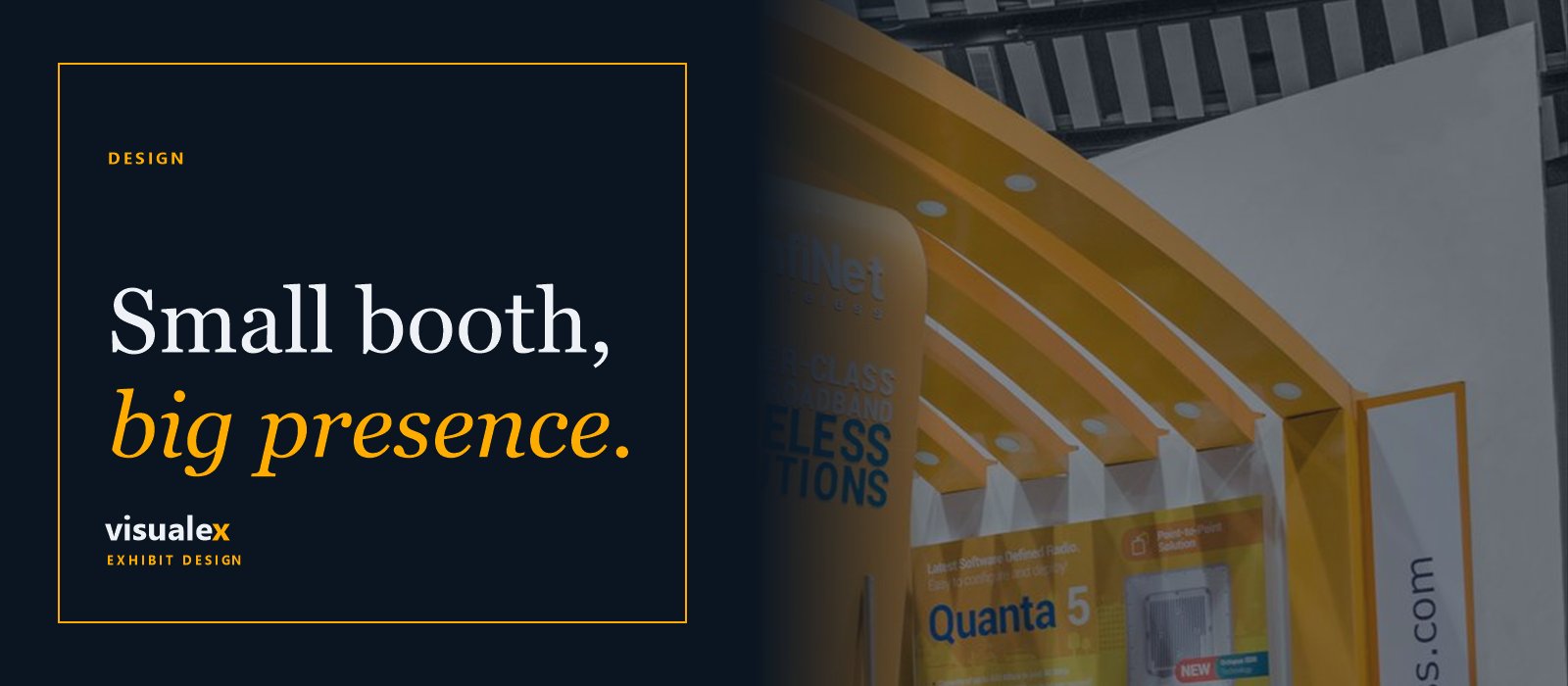
A 10x10 is not a small version of a big booth. It is a different design problem, and treating it like a scaled-down island is the most common way to waste one.
You have roughly one hundred square feet, two neighbors within arm’s reach, and about three seconds as someone walks past. Everything below follows from those three facts.
Go up, because you cannot go out
Your footprint is fixed. Your vertical space usually is not. Check the show’s height limit for inline booths, then use all of it.
Height is what makes you visible from the far end of an aisle, and visibility from a distance is the only thing that gets someone to walk toward you rather than past you. A tall, clean structural element with your name on it does more work than any amount of detail at eye level, because nobody sees the eye-level detail until they are already standing in front of you.
Light your booth, not the ceiling
Convention center lighting is flat, gray, and unflattering, and it is the same for everyone in the hall. Adding your own light is the cheapest way to look different, and in a small space it is the highest-return money you can spend.
Light the things you want people to look at: the product, the demo surface, one graphic. Do not wash the whole booth evenly, because even light creates no hierarchy and the eye has nowhere to land.
Keep the front open
The instinct in a small space is to put a counter at the front. It feels efficient. It also builds a wall between you and the aisle, and it turns your booth into a transaction window.
Pull the counter to one side or the back. Leave the front open so a visitor can step in without deciding to commit. Two people standing inside a small booth read as busy. Two people standing outside it read as a queue nobody wants to join.
One message, not five
A 10x10 that says five things says nothing. There is not enough surface area for a hierarchy of five, so all five compete at the same volume and the visitor resolves the conflict by walking on.
Pick one. One product, one claim, one reason to stop. Everything else lives in the conversation you have once they are standing there, which is the whole point of the booth.
Make the product reachable
If your product is physical, small, and safe to touch, put it where a hand can reach it without permission. Physical contact is the strongest engagement signal on a show floor and small booths are the ones best positioned to use it, because everything is already within reach.
If your product is software or a service, the same principle applies to the demo: one screen, one flow, ready to run, at standing height.
What to cut
Storage closets in a 10x10 eat the space that makes the booth work. Use a counter with a lockable cabinet instead. Cut oversized furniture, cut the second graphic wall, cut anything that exists to fill space rather than to do a job.
The test for every element: is it visible from the aisle, or does it earn its footprint once someone is inside? If it is neither, it is luggage.