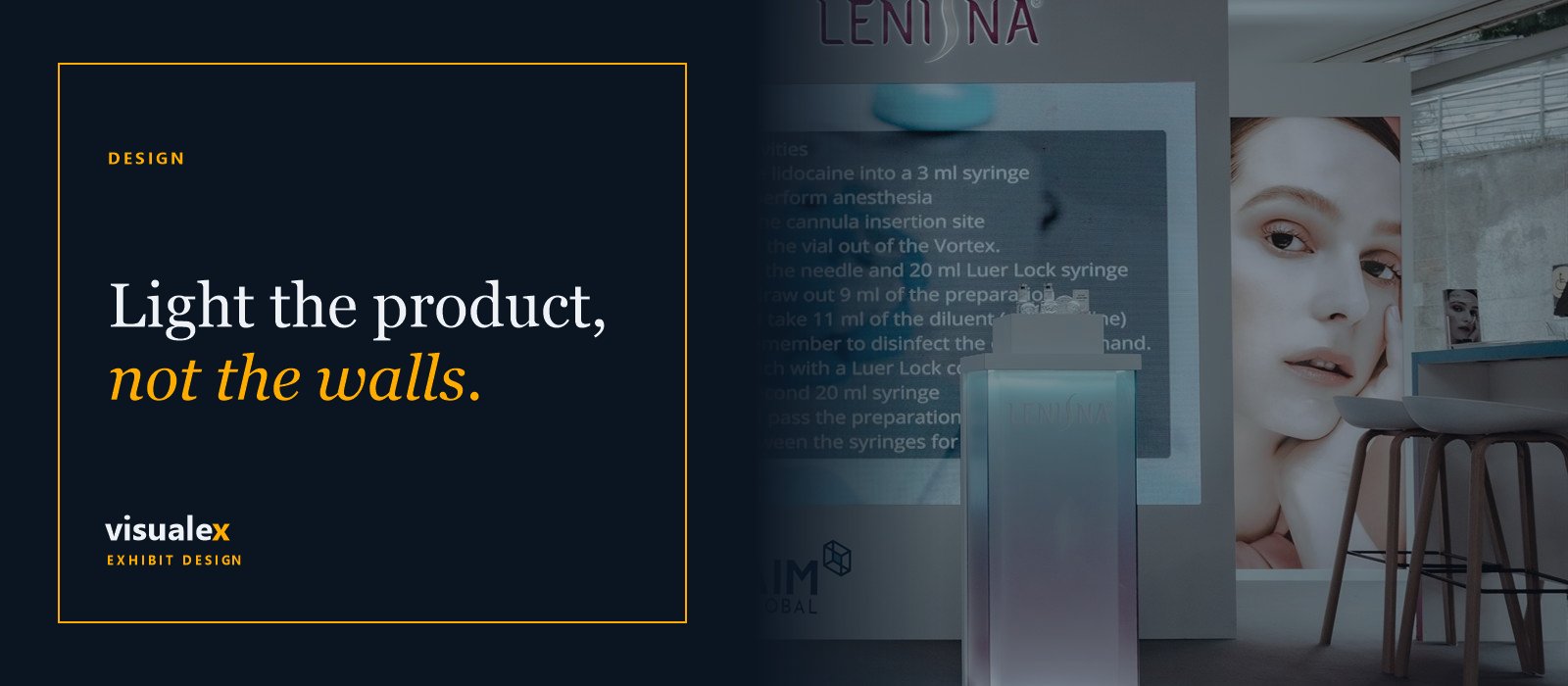
Convention hall lighting is flat, gray, and identical for everyone in the room. Adding your own is the cheapest way to look like you spent more than your neighbors, and in a small booth it is the highest-return money in the whole build.
It is also the line that gets cut first when a budget tightens, which is exactly backwards.
Why the hall works against you
Overhead hall lighting is designed to make a large space navigable, not to make anything in it look good. It comes from directly above, it is broadly even, and it flattens everything it touches. Skin looks tired, product loses shape, and finishes lose their texture.
Every booth in the room is under the same disadvantage, which is precisely why fixing it separates you.
Hierarchy beats coverage
The instinct is to make the booth bright. That is the wrong goal. Even light creates no hierarchy, and with no hierarchy the eye has nowhere to land, so a uniformly bright booth reads as busy rather than confident.
Decide what a visitor should look at first, second, and third. Light them in that order, and let everything else fall away. Contrast is what makes a space feel designed.
What to light
- The product, or the demo surface. This is almost always first.
- One graphic, usually the one carrying your single message.
- The counter or point of contact, so people know where to go.
- The structure itself, if height is doing the work of being seen.
Notice what is not on that list: the walls, evenly, everywhere.
Color temperature and your brand
Warm light flatters materials, wood, and people, and makes a space feel like somewhere to stay. Cool light reads clinical and technical, which is right for some categories and wrong for most hospitality-shaped booths.
The real trap is mixing temperatures by accident. A warm fixture next to a cool one makes both look like a mistake, and it makes your brand white look like two different whites. Specify one temperature and hold it.
Integrated versus hung
Fixtures built into the structure travel with the booth, get crated with it, and always land where the designer intended. Fixtures hung from the ceiling need rigging, approval, and lift time from the show contractor, and they carry the deadlines described in our rigging guide.
Integrated is simpler and more predictable. Hung gives you angles integrated cannot reach. Most good booths use some of both, decided at design rather than discovered on site.
Order the power early
Lighting needs electrical, electrical comes from the show contractor on a form with a discount deadline, and the drop lands where you specified on the floor plan. Specify nothing and it lands somewhere convenient for them, which is how a visible extension cord ends up crossing your own floor.
Work out your load and your drop location during design, and order it with the rest of the advance orders.
Light the product. Not the ceiling.