
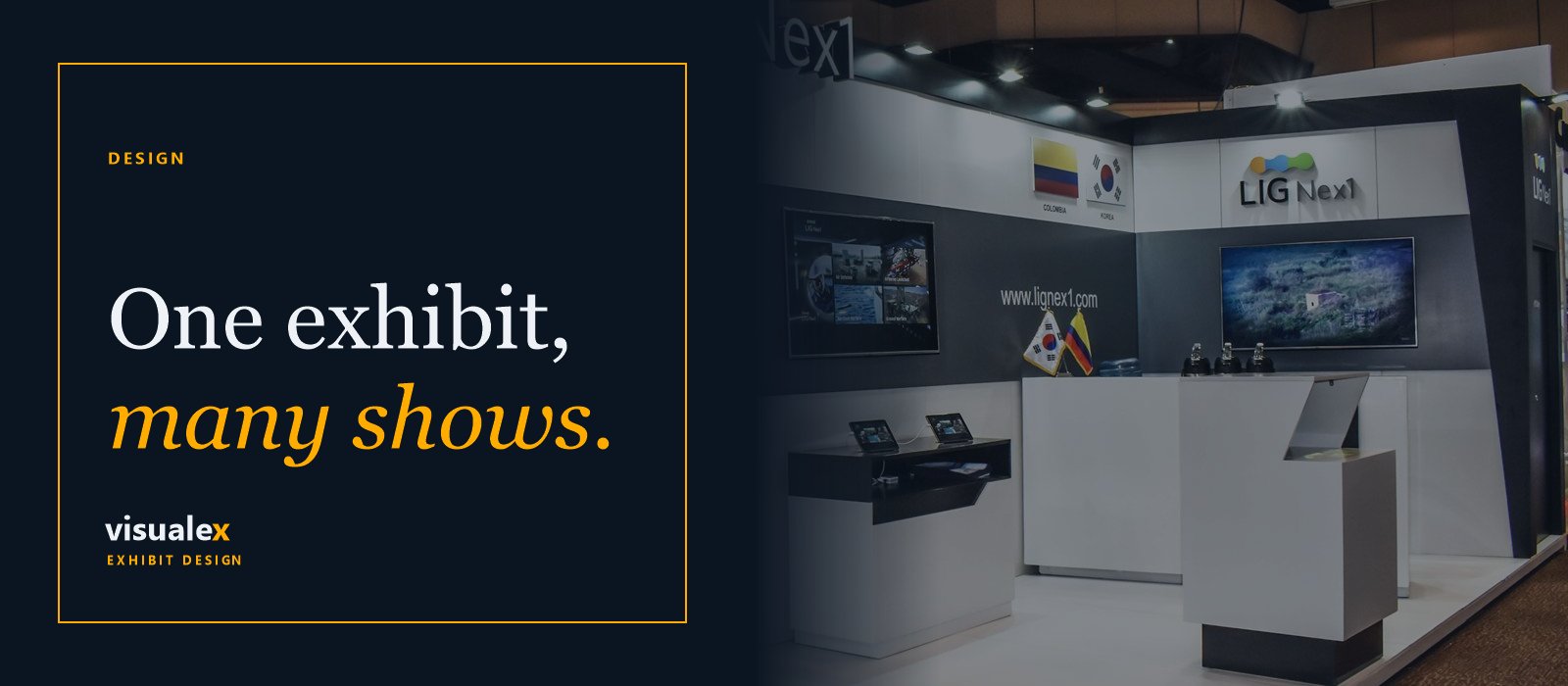
There is a difference between owning a booth and running an exhibit program. The booth is a thing you bought. The program is a system that adapts, and the second one is much cheaper per show.
Most exhibitors discover this the expensive way: they buy a booth for their biggest show, then pay to modify or replace it for every smaller one. Designed properly from the start, the same components cover a range of footprints.
Design the largest footprint first
Always. It is far easier to subtract from a well-planned island than to inflate a 10x20 into something that has to hold a 20x20 space without looking thin.
Draw the largest configuration you will realistically buy, then work out which components come out for each smaller one. That subtraction plan is the actual deliverable, not the render of the big version.
What stays fixed, what flexes
The signature structural element, the reception or demo counter, brand-critical finishes, and lighting that defines the look.
Wall runs, storage volume, meeting space, flooring area, and graphic panels sized per configuration.
Anything a visitor touches or photographs, because inconsistency here reads as a downgrade.
Anything structural and hidden, which can be systemized and reconfigured freely.
The rule of thumb: keep the things that make it recognisably yours, flex the things that only fill space.
Graphics are the easy variable
Panels are the cheapest thing to remake and the most likely to change anyway, because messaging moves faster than structure. Design the frames so a graphic swap is a fifteen-minute job and so panel sizes repeat rather than each being unique.
A booth with nine differently sized panels has nine reprint costs. One with three repeated sizes has three.
Crates follow the configuration plan
This is where adaptable booths quietly go wrong. If the crate plan assumes the full build, the small configuration ships everything, and you pay drayage on components that stayed in the box.
Crate by configuration, so a 10x20 show ships 10x20 worth of freight. See drayage, explained for why that difference compounds.
The honest limits
Adaptability is not free and it is not infinite. Systemized structure costs more up front than a single-purpose build, and a booth that stretches across too wide a range of footprints ends up optimal at none of them.
Two or three configurations is a program. Six is a compromise you will regret at every one of them.
What to ask for
Ask for the configuration drawings, not just the hero render. Ask which components appear in each. Ask for a crate manifest per configuration, and ask how long each one takes to install in crew hours.
A builder who can produce all four is quoting a program. One who can only produce the render is quoting a photograph.
Design it once. Ship what the show needs.